
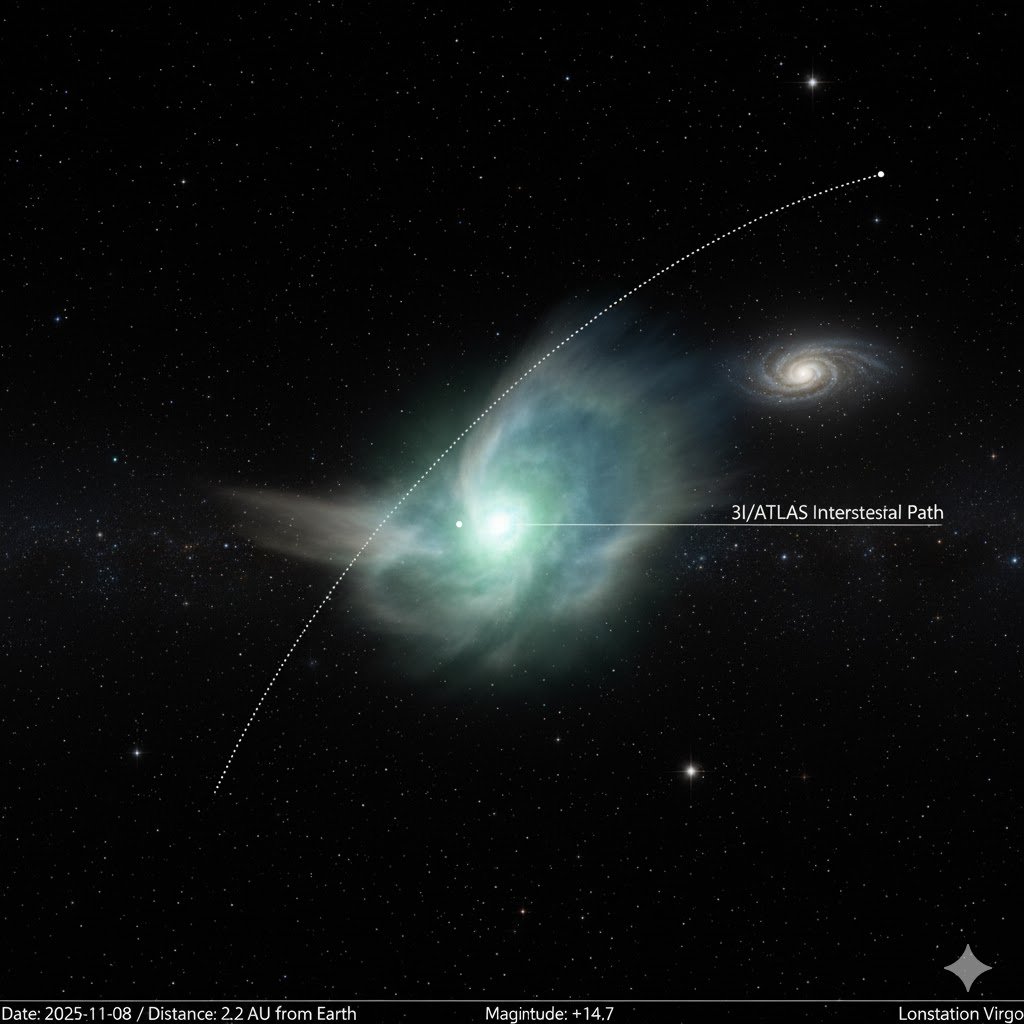
The 3I/ATLAS is a recently found an extraordinary celestial visitor to our solar system and the third confirmed interstellar object, Space Object 3I detected passing through our Solar System, discovered by the ATLAS (Asteroid Terrestrial-impact Last Alert System) telescope network. Lets find out the Discovery and Characteristics of 3I/ATLAS
Here is a summary of its discovery, characteristics, and current status as of November 8, 2025:
The interstellar comet 3I/ATLAS (formally designated C/2025 N1) is a comet that originated from outside our own Solar System, following a hyperbolic trajectory that proves it is not gravitationally bound to the Sun.
Discovery Date: July 1, 2025, by the ATLAS survey telescope located in Chile.
Nomenclature: The designation 3I/Atlas signifies it is the third confirmed interstellar visitor, following 1I “Oumuamua” (2017) and 2I “Borisov” (2019).
Composition: Initial observations suggest it is an active comet composed of volatile materials, including water ice and carbon dioxide (CO₂), similar to comets formed in our Solar System, but its rapid brightening and unusual chemical makeup suggest it is an ancient relic from another star system, potentially billions of years old.
Size: The solid nucleus is estimated to be no larger than 5.6 kilometers wide, but its coma (the surrounding cloud of gas and dust) has been observed to be massive, exceeding 26,000 kilometers across.
Closest Approaches and Anomalies
Astronomers worldwide utilized every major ground – based and space telescope (including Hubble, JWST, and Mars orbiters) to study this rare visitor.
Closest Approach to Sun (Perihelion): October 29, 2025, at a distance of approximately 1.4 Astronomical Units (AU) (just inside the orbit of Mars).
Unusual Behavior: As it neared the Sun, the object displayed several unexpected features:
Rapid Brightening: It brightened much faster than predicted for a typical comet.
Non-Gravitational Acceleration: Observations showed a slight shift in its path that cannot be fully accounted for by the Sun’s gravity alone, suggesting outgassing activity on its surface.
Lack of Prominent Tail: Post-perihelion images have been scrutinized for the absence of a large, clearly defined cometary tail, which has led to intense speculation
about its true nature and composition (including theories of an artificial origin).
Current Status as of November 8, 2025:
3I/ATLAS has successfully passed perihelion and is currently beginning its journey out of the Solar System, though it remains a prime target for observation.
Distance and Visibility:
- It is now visible in the predawn hours in the eastern sky, moving through the constellation Virgo.
- It is currently at a distance of about 2.2 AU from Earth.
- The comet is still faint, estimated at around magnitude 14.7 (visual), requiring a large amateur or professional telescope (10-inch aperture or larger) for viewing under dark skies.
- Next Closest Approach to Earth: The comet will make its final and closest pass to Earth on December 19, 2025, at a safe distance of approximately 1.8 AU (about 270 million km), before receding permanently into interstellar space.
Active Research:
Scientists are continuously monitoring the object to measure its non-gravitational effects and to confirm whether it develops a more visible dust or gas tail as it moves away from the Sun, which would help settle the debate over its natural cometary origin.
3I/ATLAS, Interstellar object 3I/ATLAS, Comet 3I/ATLAS, Third interstellar object, 3I/ATLAS status November 2025, C/2025 N1, 3I/ATLAS non-gravitational acceleration, 3I/ATLAS alien technology debate, 3I/ATLAS perihelion date, 3I/ATLAS trajectory, 3I/ATLAS closest approach to Earth, 3I/ATLAS images, 1I/ʻOumuamua, 2I/Borisov, Interstellar comet vs asteroid, ATLAS telescope discovery, NASA NTSB 3I/ATLAS, JWST 3I/ATLAS observation, Tianwen 1 3I/ATLAS, How to see 3I/ATLAS, 3I/ATLAS visibility, Comet viewing November 2025, 3I/ATLAS magnitude












Leave a Reply